Critical software modernization without downtime runs as a sequence of small, reversible releases, not a big-bang rewrite. The usual path: route traffic through a facade, extract capabilities one at a time, run old and new systems in parallel behind reconciliation checks, automate testing and deployment, and cut over only when measured parity holds under production load.
Short answer: modernization without a big-bang cutover
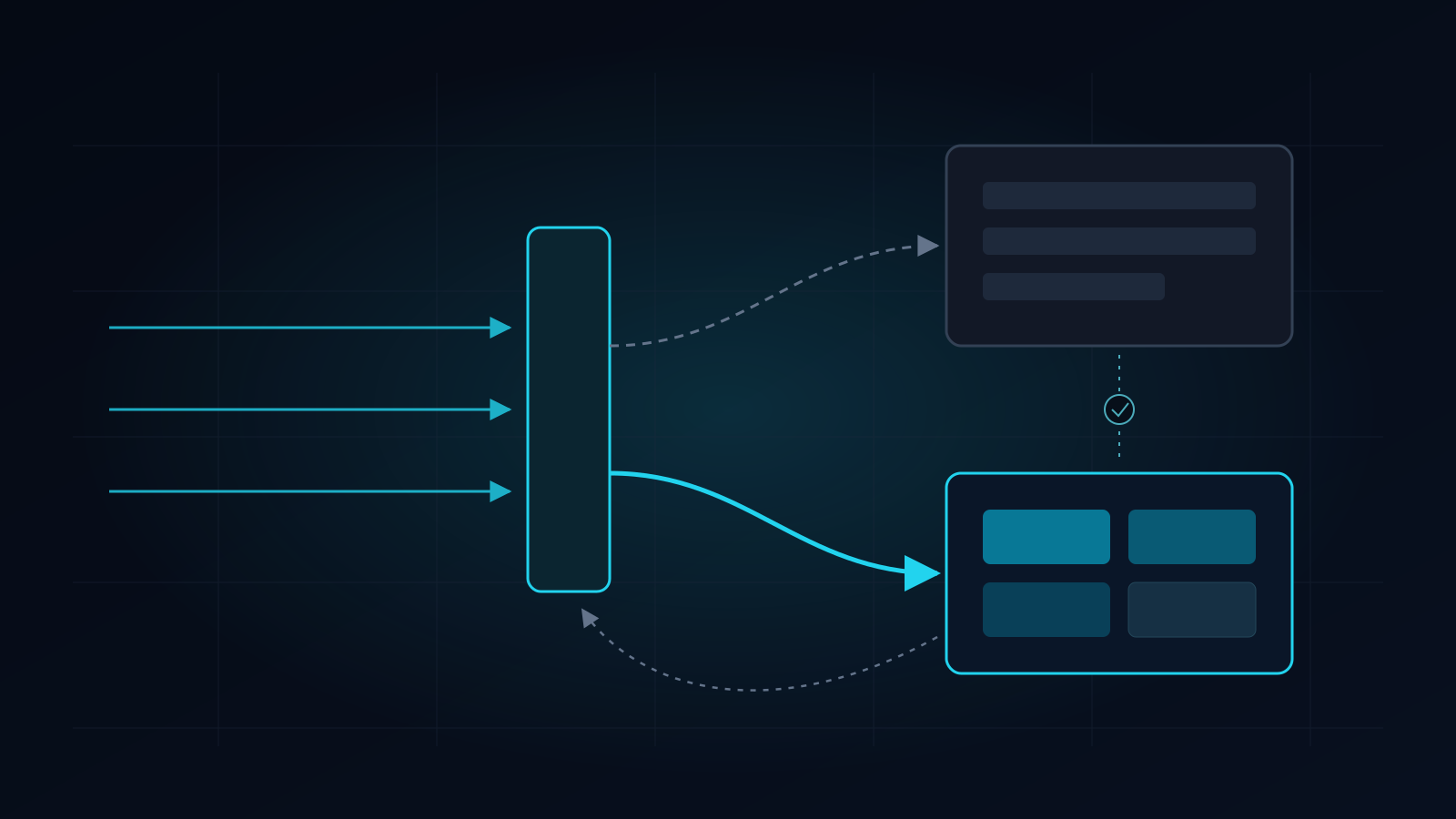
The method is the strangler facade. A routing layer goes in front of the legacy system. Behind it, capabilities move to the new platform through incremental extraction, one at a time. Each moved capability goes through a parallel run: both systems process the same work and a reconciliation report compares the results. Traffic shifts only when measured parity holds, and it can shift back in minutes.
The business keeps running because no single release is allowed to be the only one. Every step has a way back, an owner who decides, and evidence that it worked.
What makes software “critical”, and why that changes the method
Critical is not a synonym for old. A system is critical because of what happens when it fails:
- Transaction integrity: it moves money, inventory, claims or orders.
- Regulatory obligation: a supervisor, auditor or contract expects it to behave in documented ways.
- Revenue path: customers cannot buy, pay or be served without it.
- Safety: people or equipment depend on its outputs.
- Irreplaceable knowledge: the business rules exist only in the code and a few people’s heads.
That definition sets the operating rule for everything below. Every change must be reversible (you can undo it without a recovery project), observable (you can see its effect in production while it happens) and independently verified (someone other than the builder confirms it behaves as intended). A plan that cannot show all three per release is not yet a plan for a critical system.
Why rewrites fail more often than they succeed
The failure is structural. The old system keeps changing while the new one is built, so the rewrite chases a moving target. The domain knowledge lives in people and code, not in documents. The work is funded once but runs for years. And the cutover is treated as a date rather than a sequence of rehearsed reversals, so when the date arrives there is no smaller step to take. For critical systems, the rewrite carries the burden of proof.
The five techniques that keep the business running
The techniques below are how legacy modernization through pragmatic, phased roadmaps works in practice. Each has a named artefact, because a technique without an artefact cannot be audited.
1. Incremental refactoring with a strangler facade
The pattern takes its name from Martin Fowler’s strangler fig application. The facade is a routing and translation layer in front of the legacy system. It has four jobs:
- Route each request to the old or new implementation, by capability, percentage or segment.
- Translate between the legacy interface and the new one, so callers do not change.
- Log every routing decision, so behaviour can be reconstructed.
- Move traffic back in minutes, by configuration, without a deployment.
Artefact: the routing table, under change control, showing which capability is served where.
2. Parallel run and reconciliation
Old and new process the same work: mirrored live traffic or replayed production traffic. Outputs are compared field by field. The reconciliation tolerance is the agreed definition of “the same”: exact match for balances, a defined margin for derived values, an explicit list of accepted differences.
Artefact: the reconciliation report, with a named owner and an acceptance threshold agreed before the first cutover.
3. Data migration as a continuous discipline
Most outages hide here. Separate schema, data and access. During the transition, keep systems consistent with dual-write or change data capture, run backfills that are idempotent so they can be repeated safely, and keep a documented rule for which system is the authoritative system for each entity at any moment. This is where data platforms, pipelines and governance work meets the application migration.
Artefact: the authority map, by entity and date.
4. Test automation and release discipline
Modernization runs on DevOps; it is not an add-on at the end. That means contract tests at the facade, synthetic and replay-based regression suites, feature flags to separate deployment from release, blue-green or canary releases, and infrastructure as code so every environment is reproducible. The run model after cutover matters as much as the build: DevOps, observability and operating the platform after cutover.
Artefact: the release record per change, with test evidence attached.
5. Hybrid and multi-cloud integration
For a while the estate is hybrid, and that has real costs: identity federation across environments, network paths and latency budgets between old and new, data residency and egress charges, and a service boundary designed to survive a future change of cloud. Multi-cloud is a constraint to manage, not a goal to pursue.
Artefact: the integration contract per boundary, including latency and residency limits.
A single cutover, step by step
An illustrative sequence for one capability. Percentages and windows are set per system.
- Shadow. The new path receives mirrored traffic and returns nothing to users. Reconciliation runs. Rollback trigger: none needed; promotion requires the tolerance to hold.
- Canary, small slice (for example, 1%). Real users, low exposure, observed through at least one full business cycle, including the peak and the batch run. Rollback trigger: any reconciliation break above tolerance, any error-rate or latency breach against the agreed baseline.
- Widen (for example, 10%, then 25%). Same triggers, plus capacity checks on both sides. Each step has its own observation window, agreed in advance.
- Majority (for example, 50%, then 90%). The legacy path is now the fallback. Rollback trigger unchanged; the routing table can still return all traffic in minutes.
- Full traffic. The legacy path stays deployed and reachable but idle, still reconciling where possible.
- Go/no-go to retire. The named owner signs off against the reconciliation report and the release record. Only then does the capability enter decommissioning.
A rollback is never a failure of the method. An unrehearsed rollback is.
How to keep a regulated system running through the migration
A compliance or audit function will look for six things across both systems:
- Change control with pre-approved release windows, so small releases do not each wait for a committee.
- Evidence retained per release: test results, approvals, the reconciliation report and the routing change.
- Segregation of duties between the people who build a change and the people who release it.
- Access reviews covering the legacy system, the new platform and the facade.
- Audit trails on both sides during the parallel run, so any transaction can be traced regardless of which system served it.
- Sector notification or validation obligations. Some regulators expect notice of material changes to critical systems, or validation before go-live. Which obligations apply is for the client’s compliance and legal functions to confirm; this is not legal or compliance advice.
Where the client’s sector requires assurance, ISO/IEC 27001 and SOC 2 are the usual reference frameworks for how these controls are organized and evidenced.
Which providers modernize critical software for large enterprises? What to ask, what to hear
No ranking of named firms answers this well. Understand the four kinds of provider, then ask each the same questions.
- Independent specialist: fits a defined system, a date and a rollback plan.
- Systems integrator or large consultancy: fits multi-domain, multi-vendor estates.
- Platform-tied partner: fits standard workloads already on that partner’s stack.
- Internal team: fits one system with stable scope and a strong bench.
Seven criteria, with the evidence to demand:
- Continuity under regulation. A system they migrated that is still in production under an equivalent regulatory regime. Logos are not evidence.
- Sequence and rollback. The migration sequence and the rollback plan, with triggers and a rehearsed rollback time.
- Risk they did not create. How they price what the legacy system hides: undocumented rules, dirty data, missing tests.
- Cutover ownership. The name and role of the person who owns the go/no-go, not a diffuse committee.
- Knowledge transfer. How it is enforced: contractual deliverables, pairing, runbooks your team can run.
- Platform conflict. Whether they compete with, or resell, the platform you already own, and whether they disclose it.
- Month eighteen. What happens after go-live: who owns decommissioning, the forgotten integrations and the licence tail.
Who should modernize a critical system — the four options and their trade-offs
| Dimension | Independent specialist | Systems integrator / large consultancy | Platform-tied partner | Internal team |
|---|---|---|---|---|
| Accountability at cutover | Named engineer owns the go/no-go | Shared across workstreams | Shared with the platform vendor | Clear, but capacity-bound |
| Incentive to finish | Paid for increments and decommissioning | Programme economics reward extension | Rewards depth in one stack | Competing day-job priorities |
| Platform neutrality | Must disclose resale relationships | Varies by practice | Recommends its own stack | Neutral by default |
| Knowledge transfer | Explicit, contractual | Often a separate workstream | Bundled with the platform | Native, if retention holds |
| Throughput risk | Capacity limits | Heavy governance, slower starts | Fast inside the stack | Backfill risk |
| Best fit | A defined system, a date, a rollback plan | Multi-domain, multi-vendor estates | Standard workloads already on that stack | One system, stable scope, strong bench |
Platform choice is yours; the provider should not decide it for you
Modernization usually means choosing a target: Azure, AWS or Google Cloud for the application, and often Databricks, Snowflake, Microsoft Fabric or BigQuery for the data that moves with it. If the modernized system includes AI components, the same applies to Azure OpenAI, Amazon Bedrock or Vertex AI. Make that choice on workload fit, data residency, governance and lineage, cost model and exit cost. Record it as a decision with the alternatives you discarded.
54-4 holds resale agreements with Microsoft and AWS; its business is services — fixed-scope engagements and pod-style squads — not licenses, so platform guidance is not tied to which license is sold. Ask any other candidate for the same disclosure in writing.
A phased engagement model that matches the method
| Phase | Objective | Key deliverables | Exit criteria | What the business sees |
|---|---|---|---|---|
| Assess and baseline | Understand the system and its risk | Dependency map, capability inventory, initial test net, authority map | Prioritized capabilities, open risks logged | A plan with named risks, no change in production |
| Facade and first extraction | Prove the method in production | Facade, routing table, first capability migrated, rehearsed rollback | Real traffic on the new path with rollback available | A first capability served by the new platform |
| Parallel run and widen | Increase coverage with parity | Reconciliation reports, further capabilities, release records | Tolerance sustained under production load | Steady releases without interruption |
| Decommission and handover | Retire the legacy system with evidence | Archive, retired credentials, runbooks, licence tail closed | Nothing calls the old system | One system to run, and lower legacy cost exposure |
The three commercial models map onto these phases:
- Time & Materials for assess and baseline, when discovery will change the scope.
- Dedicated Engineering Cells for parallel run and widen, when a stable team has to follow an evolving backlog.
- Turnkey Projects for a well-defined extraction or the decommission, when outcome and milestones can be fixed.
What a decommission actually requires
It requires:
- Proof that nothing still calls the old system: traffic logs, network flows and batch schedules, checked over a full business cycle.
- Retired credentials and integrations: service accounts, API keys, file transfers and partner connections.
- Data archived in a retained, readable form, meeting retention obligations without keeping the old application alive.
- The contract and licence tail closed: support contracts, licences, hosting.
- Updated runbooks and audit record, so the next auditor sees one system, not two.
Then watch the two-year tail: the licence that auto-renews, the batch job nobody remembered. That is where the real risk sits.
What this looks like in practice
54cuatro, of which 54-4 is a division, has developed software for Provident, applying strong engineering best practices sustained over time. The aim was a faster time to market without stopping operations: the same principle of small, verified releases this page describes.
Frequently asked questions
Can critical software be modernized without shutting it down?
Yes. The standard approach keeps the legacy system live behind a routing facade and moves one capability at a time to the new platform, running both in parallel and comparing outputs until parity holds. No release requires the business to stop, and every step can be reversed within minutes.
How long does legacy modernization usually take?
It depends on the number of capabilities, the quality of the data and the regulatory review path, not on the size of the codebase alone. A phased plan should put a first production cutover early, on a small capability, and estimate the rest once that cutover has been measured. Treat any single-date, whole-system estimate with suspicion.
Is a full rewrite ever the right answer?
Sometimes, when the system has no reusable behaviour, no regulatory constraint on continuity and a small, well-understood domain. For critical systems the burden of proof sits with the rewrite, because it defers all the value to the end and concentrates all the risk in one cutover.
What is the strangler pattern in legacy modernization?
A facade is placed in front of the legacy system to intercept calls, and capabilities are extracted behind it one at a time until the old system handles nothing. The legacy system keeps running throughout, and traffic can be routed back at any point, which is what makes the approach safe for critical workloads.
How do you prove the new system behaves like the old one?
By running both in parallel on real or replayed traffic and reconciling outputs against a defined tolerance, then promoting only when that tolerance holds under production load. The reconciliation report, its owner and its acceptance threshold should be agreed before the first cutover, not after.
What should we ask a modernization provider before signing?
Ask for a system they migrated that is still running under a comparable regulatory regime, their rollback plan for a failed cutover, who owns the go/no-go decision, how knowledge transfer is enforced, and what decommissioning includes. Ask also whether they resell the platform they are recommending.
Next step
If you have a specific system in mind, the useful next step is a modernization readiness review of that one system: its dependencies, its test net, its data authority and the first cutover it could safely take.
Let's talk about your next platform
54-4 builds and modernizes business-critical software with senior teams across the Americas.
Schedule a consultation